

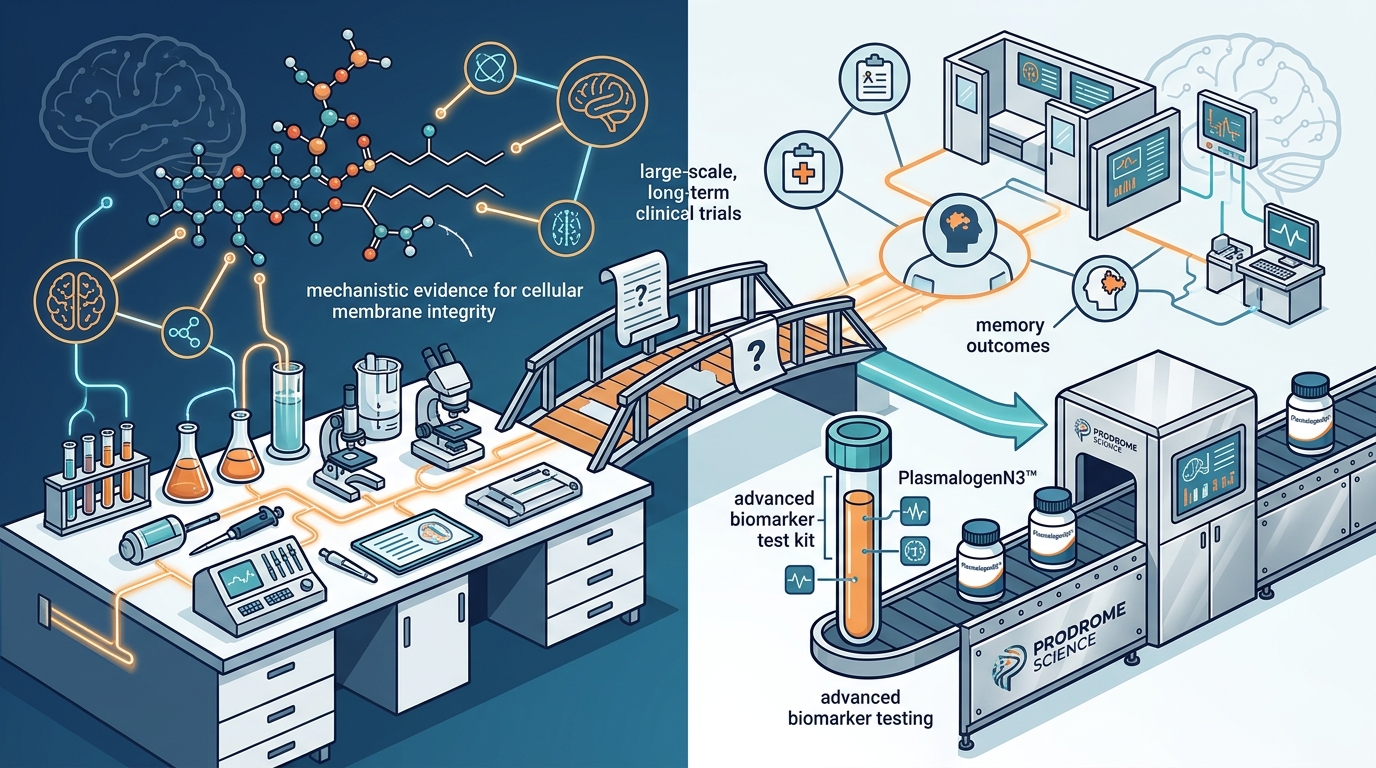
Current plasmalogen research provides strong mechanistic evidence for cellular membrane integrity but lacks large-scale, long-term human clinical trials specifically isolating memory outcomes. While we know plasmalogens are critical structural lipids in the brain, the precise dosing, duration, and individual variability required to support healthy cognitive function remain under investigation. Prodrome Science focuses on bridging this gap by providing high-potency precursors and advanced biomarker testing to help individuals and practitioners navigate this evolving landscape. according to New research indicates
The Structural Basis of Memory Support
Plasmalogens are a unique class of ether phospholipids that serve as essential structural components of cell membranes. They are particularly concentrated in the brain, where they support the fluidity and stability of neuronal membranes. This structural role is fundamental to efficient signal transmission between neurons, which is the physical basis of memory and learning.
Research indicates that the vinyl ether bond in plasmalogens provides unique antioxidant properties, helping to protect membrane lipids from oxidative stress. This protection is vital for maintaining the integrity of synaptic connections over time. However, while the structural importance is well-documented, the direct translation of membrane stability into measurable memory performance in healthy adults is still being mapped.
Prodrome Science emphasizes that understanding this structural foundation is the first step in supporting brain health. By focusing on the building blocks of the cell, we aim to provide a foundation for long-term neurological wellness.
Limitations in Current Clinical Evidence
Despite decades of laboratory research, the clinical evidence for plasmalogen supplementation in healthy populations remains limited. Most existing studies have focused on specific metabolic conditions or have been conducted in animal models, which do not always translate directly to human outcomes. There is a significant gap in large-scale, randomized controlled trials that measure cognitive function in healthy adults using standardized memory tests.
Furthermore, the heterogeneity of plasmalogen species complicates research. Different types of plasmalogens, such as those containing omega-3 versus omega-9 fatty acids, may have distinct roles in different brain regions. Current studies often do not distinguish between these specific species, making it difficult to draw precise conclusions about which type is most effective for specific cognitive tasks.
This lack of granular data means that practitioners and consumers must rely on a combination of mechanistic understanding and emerging observational data. Prodrome Science addresses this by offering both PlasmalogenN3™ (formerly ProdromeNeuro) and PlasmalogenN9™ (formerly ProdromeGlia), allowing for targeted support based on individual needs.
Biomarker Variability and Individual Response
One of the most significant research gaps is the wide variability in baseline plasmalogen levels among healthy individuals. Factors such as age, diet, genetics, and metabolic health influence these levels, but the optimal range for supporting memory is not yet defined. This variability makes it challenging to establish a universal dosing recommendation that works for everyone.
Traditional blood tests do not typically measure plasmalogen levels, leaving many individuals unaware of their baseline status. Prodrome Science developed the ProdromeScan™ to measure these key lipid biomarkers, providing a snapshot of cellular health. By measuring deviations from optimal health, individuals can make informed decisions about their nutritional support. This approach shifts the focus from treating symptoms to maintaining structural integrity.
The ability to measure these biomarkers is a crucial step in personalizing memory support. It allows for a more precise understanding of how an individual’s cellular environment may influence their cognitive function.
Dosage and Duration Uncertainties
Determining the optimal dosage and duration of plasmalogen supplementation is another area where research is ongoing. While some studies suggest that consistent intake over several months is necessary to see changes in membrane composition, the specific timeline for cognitive benefits is unclear. The body’s ability to incorporate these lipids into existing membranes is a gradual process, and the rate of this incorporation varies by individual.
Additionally, the interaction between plasmalogens and other nutrients, such as phosphatidylcholine, is not fully understood. Prodrome Science offers products like Glia PC+ and Neuro PC+ that combine plasmalogens with phosphatidylcholine to support overall membrane health. These combinations are designed to provide a comprehensive approach to lipid nutrition, but the specific synergistic effects on memory are still being explored.
Until more data is available, a conservative and consistent approach to supplementation is recommended. Working with a healthcare professional can help tailor a plan that aligns with individual health goals.
Future Directions in Plasmalogen Research
The future of plasmalogen research lies in integrating advanced imaging techniques with biomarker analysis. By combining structural data from brain imaging with lipid biomarker profiles, researchers may be able to better understand the relationship between membrane health and cognitive function. This multidisciplinary approach will help to fill the current gaps in our understanding.
Prodrome Science is committed to advancing this field by supporting research and providing high-quality products. Our team, led by Dr. Dayan Goodenowe, continues to explore the biochemical foundations of health. For those interested in deeper education, the Elite Practitioner Program offers advanced training in lipid biology and plasmalogen science.
As the field evolves, staying informed and working with qualified professionals will be key to navigating the complexities of memory support. The goal is not to promise cures, but to provide the tools and knowledge necessary for maintaining optimal cellular health.
Key Takeaways
- Plasmalogens are essential structural lipids that support membrane integrity and signal transmission in the brain.
- Current clinical evidence is limited by a lack of large-scale human trials specifically focused on memory outcomes in healthy adults.
- Baseline plasmalogen levels vary significantly among individuals, making universal dosing recommendations difficult.
- Biomarker testing, such as the ProdromeScan™, can help measure deviations from optimal lipid health.
- Different plasmalogen species, such as omega-3 and omega-9, may have distinct roles in different brain regions.
- Future research will likely integrate imaging and biomarker data to better understand the link between membrane health and cognition.
Frequently Asked Questions
What are plasmalogens and why are they important for memory?
Plasmalogens are specialized ether phospholipids that are key components of cell membranes. They are important for memory because they support the structural integrity and fluidity of neuronal membranes, which is necessary for efficient signal transmission.
Can plasmalogen supplements improve memory?
Plasmalogen supplements support the structural integrity of cell membranes, which is fundamental to healthy brain function. However, they are not intended to diagnose, treat, cure, or prevent any disease. Individual results may vary, and more research is needed to fully understand their impact on memory.
What is the difference between PlasmalogenN3™ and PlasmalogenN9™?
PlasmalogenN3™ (formerly ProdromeNeuro) contains omega-3 plasmalogen precursors, which are associated with gray matter and synaptic function. PlasmalogenN9™ (formerly ProdromeGlia) contains omega-9 plasmalogen precursors, which are associated with white matter and myelin integrity.
How long does it take to see benefits from plasmalogen supplementation?
The timeline for seeing benefits can vary by individual. Since plasmalogens are structural components of cell membranes, it may take several months of consistent supplementation to observe changes in membrane composition. Working with a healthcare professional can help guide this process.
Is the ProdromeScan™ a diagnostic test?
No, the ProdromeScan™ is not a diagnostic test. It is a biomarker test that measures key lipid levels to provide a snapshot of cellular health and deviations from optimal health. It is intended for research, educational, and informational use only.
Where can I find more information about plasmalogen science?
You can explore our science blog and publications for more detailed information on plasmalogen research. Additionally, the Elite Practitioner Program offers advanced training for healthcare professionals interested in lipid biology.
Conclusion
While the research on plasmalogens for memory support is still evolving, the structural importance of these lipids is well-established. By understanding the current gaps in clinical evidence and utilizing advanced biomarker testing, individuals can make more informed decisions about their brain health. Prodrome Science is dedicated to providing high-quality, science-based products and education to support this journey. To learn more about our products and the science behind them, visit our plasmalogen guide or explore our science blog. For those in the healthcare field, consider joining the Elite Practitioner Program to deepen your expertise in lipid biology.
These statements have not been evaluated by the Food and Drug Administration. This product is not intended to diagnose, treat, cure, or prevent any disease.